

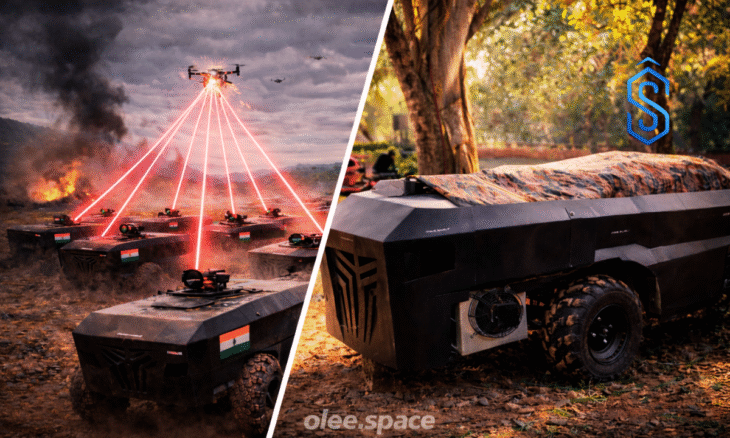
Pune: India has taken a decisive step forward in next-generation battlefield technology with the unveiling of the olee.space AI Laser Sniper, the world’s most compact 2-kilowatt AI-enabled laser sniper system mounted on an Unmanned Ground Vehicle (UGV).
Developed by indigenous defence technology firm olee.space, the AI laser sniper system has successfully completed field testing with key stakeholders and is now ready for operational deployment and sale, officials familiar with the programme confirmed.
Designed as a Directed Energy Weapon (DEW) for close-combat and perimeter defence, the AI laser sniper system can neutralise, dazzle, or functionally damage hostile personnel, vehicles, and equipment within seconds, offering a rapid, non-kinetic response to emerging threats.
Defence analysts see this as a critical capability for modern warfare, where speed, precision, and autonomy increasingly define tactical advantage.
Also Read: Former BEL CMD Venkateswara Gowtama Mannava Joins Olee.Space as Strategic Production Advisor
olee.space AI Laser Sniper strengthens autonomous ground warfare capabilities
Commenting on the milestone, James Solomon, Founder & CEO, olee.space, said, “This development represents a decisive shift in how ground combat and perimeter defence will be approached in the future. By combining directed energy, artificial intelligence, and autonomous mobility in an extremely compact form factor, we have created a system that enhances battlefield effectiveness while significantly reducing risk to human lives.
This platform reflects our commitment to building indigenous, future-ready defence technologies aligned with India’s strategic and self-reliance objectives.”
AI Laser Sniper UGV Platform: Extremely Compact Footprint
One of the most significant advantages of the platform is its extremely compact footprint. The UGV measures approximately 5 feet by 3 feet, weighs less than 250 kilograms, and is powered by a diesel engine, making it both rugged and logistically efficient.
With a fuel-efficient operational range exceeding 130 kilometres, and extendable further with larger fuel capacity, the system is suited for prolonged missions in remote and high-risk environments.
Its compact size allows deployment in urban combat zones, border areas, forested regions, deserts, and rugged terrains, where conventional armoured systems are impractical.
Despite its small form factor, the platform delivers high-precision laser engagement capable of neutralising threats almost instantaneously.
The UGV-based laser sniper is equipped with advanced artificial intelligence and machine-learning algorithms, enabling autonomous navigation, target recognition, and engagement.
The system can be deployed autonomously at the press of a button, allowing rapid response without exposing personnel to immediate danger.
A defining feature of the platform is its ability to operate in coordinated swarm formations. Multiple UGVs can work together to secure perimeters, dominate tactical zones, and create a protective shield around critical assets.
Also Read: olee.space Appoints Former IAF Assistant Chief Rajiva Ranjan as Strategic Defense Advisor
Defence experts describe this as one of the most advanced ground-based swarm laser weapon systems developed globally, capable of denying access and neutralising threats with high reliability.
The system is designed to operate alongside infantry units and special forces, particularly in close-combat scenarios. By handling high-risk engagements autonomously, it reduces exposure of soldiers during operations involving inland threats, perimeter breaches, and hostile incursions.
Its capability to engage known targets within unknown or dynamically changing environments places it within the emerging domain of machine-to-machine warfare, where autonomous systems cooperate, adapt, and respond faster than traditional command-driven platforms.
Following successful field trials conducted with crucial defence stakeholders, the platform has reached operational readiness. olee.space is currently in active discussions with international defence and security clients allied with India, signalling growing global interest in India’s indigenous directed energy and autonomous combat capabilities.
The AI laser sniper UGV platform strengthens India’s position in directed energy weapons, autonomous ground systems, and AI-driven defence platforms. The compact UGV laser sniper offers a cost-effective, scalable, and rapidly deployable solution for securing defence perimeters, strategic installations, and sensitive inland locations.
With this AI laser sniper UGV platform, India moves closer to establishing a home-grown, autonomous defensive shield across land and complex terrains, reinforcing national security while advancing the country’s long-term vision of technological self-reliance in defence.
olee.space is a photonics and defense technology company based in Pune, India. It builds next-generation systems in Free-Space Optical Communication (FSOC) and directed energy weapons, catering to India’s defense, aerospace, and telecom sectors.